
The H Corp Foundation Prepares to Meet This Moment in History
Read the recap on our soft launch event and how to get involved with us on Zoom this Wednesday May 20, 2026

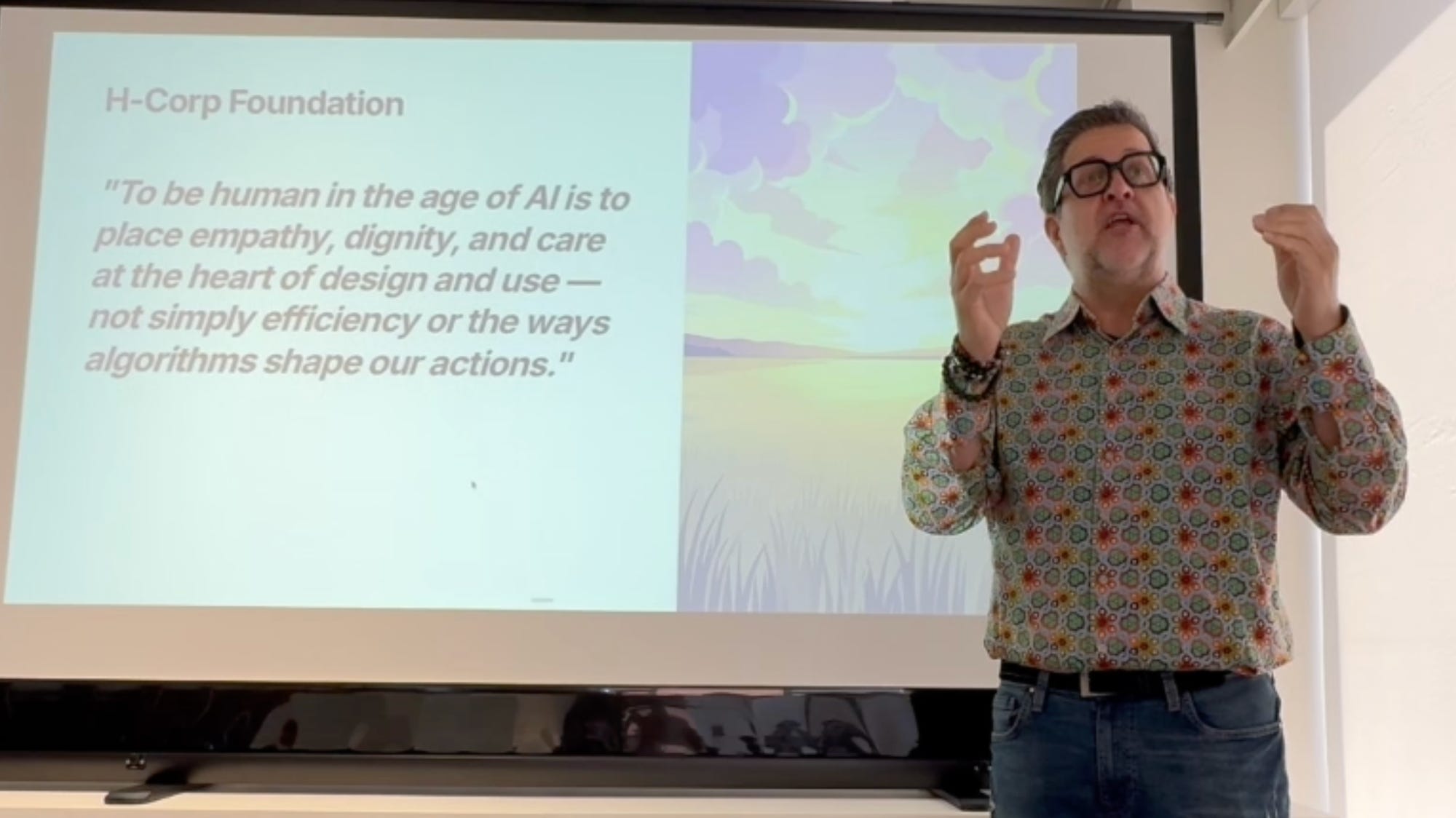
H Corp Founder Chris Heuer kicks off the conversation at JVS in San Francisco during Human+Tech Week on May 13, 2026 with the support of Outhink.
What It Means to Be Human-Centered: A Report From the Room
A recap of the H-Corp Foundation’s soft launch event and world cafe, and an invitation to go deeper with us this Wednesday.
TLDR
H-Corp Foundation held its first in-person World Café during Human+Tech Week in San Francisco on May 13, 2026
A dozen practitioners, researchers, and leaders spent 90 minutes asking: what does a genuinely human-centered organization actually do?
Twelve themes emerged — from certification design to employee voice to the empirical case against AI replacement
The full report is below
Join us Wednesday May 20 at noon PT to go deeper: Register here
We didn’t set out to build a certification body. We set out to answer a harder question.
In the spring of 2025, a small group of people started meeting regularly to explore human flourishing and human agency in the era of AI and automation. They begun exploring what it would actually mean for an organization to be human-centered. Not in its branding, but in its operations. In its leadership decisions. In how it responds when AI efficiency conflicts with human dignity. That conversation became the H-Corp Foundation, now incorporated and brought to life.
Last week, during Human+Tech Week in San Francisco, we convened in person for the first time — hosted by JVS, Jewish Vocational Services, an organization whose mission to connect underserved talent with meaningful opportunity is itself a living demonstration of what we’re trying to formalize. Dave Toole of Outhink made the afternoon possible by helping produce and buy lunch for attendees.
The format was a World Café: small groups, rotating, structured questions, no slides, no pitches. Three questions drove the conversation: what are the principles, what are the policies, and how does a human-centered organization actually live its values day to day?
Twelve themes are documented in the report below. They range from the certification architecture and plans: a three-phase model built on employee voice, not just executive self-attestation; to the empirical business case that makes the CFO conversation possible; and to the harder questions we’re still sitting with: what happens when a certified company breaks its pledge?
We’re not pretending we have all the answers. That’s the point. H-Corp will grow in phases as a movement first, a standard second, and a certification third. This report is evidence of the movement.
The full report follows as well as the agenda for our call on Wednesday May 20. A video introduction is embedded below for those who want context before the data.
If you want to be in the room where this moves one more step forward — join us Wednesday.
→ Register for the May 20 Zoom | Noon PT
But first: A Note About Our Gracious Host
JVS Bay Area is a nonprofit workforce development organization that helps people build skills, access training, and secure quality jobs that lead to long-term economic mobility. Working across California, JVS partners with employers, community organizations, and public agencies to connect jobseekers to careers in healthcare, skilled trades, technology, and other high-demand industries.
At a time of rapid change in the labor market and growing economic uncertainty, JVS is helping ensure that workers are not left behind. Through career training, coaching, job placement support, and employer partnerships, JVS helps individuals and families build stability and opportunity while strengthening the workforce our communities and economy depend on.
There are many ways to support JVS’s work, including making a donation, partnering as an employer, hiring graduates, attending events, or helping amplify our mission and impact. Learn more and sign up for our newsletter at jvs.org.
H-Corp Foundation Conversation Report
Source: Closing session of our Human+Tech Week soft launch event from May 13, 2026
Theme 1: Leadership AI Literacy is the Missing Layer
What the room said: Leadership doesn’t understand AI’s power or its trade-offs. They can’t make good policy decisions without that understanding. CEOs are forming their views from peer conversations, not from alternative perspectives. So the same bad mental models circulate at the top of organizations and are amplified by all forms of media. One speaker proposed a structured program: part change management, part AI comprehension, designed for leadership teams specifically. Another framed it as a quarterly planning integration question — what’s the next H-Corp project on this strategy for leadership this quarter?
Connected point — the CFO translation gap: Another speaker named something precise: H Corp Foundation’s research and framing gives CMOs the language to walk into a CFO’s office and make the case. The CFO isn’t hearing it from the organization; they’re hearing it filtered through someone who’s already convinced. That’s a leverage point, not a limitation. It means H-Corp’s audience isn’t just CEOs; it’s the people who brief CEOs.
What this means for H-Corp: Leadership education is a gap that multiple people in this room independently named. The certification model incentivizes changes in organizational behavior. But if leadership doesn’t understand the landscape, the behavior won’t change, and the certification becomes decorative. An education program is envisioned as a foundational activity of the H Corp Foundation directly and through other organizations providing transformation services, leadership coaching, and workforce training.
Theme 2: Certification — Three Phases, Employee-Verified, Revocable
The core challenge: How do you actually test whether a company is human-centered? You can’t. Not directly. Or at least we don’t have a good answer for that yet, though we have some good ideas in that direction from measures such as the Thrivability index and the ROI of Care framework. A few people in the room noted that companies only get tested in the decisions they make under pressure. Layoffs during a downturn, automation choices during a cost-cutting cycle, or how they respond when AI goes wrong. One speaker framed it cleanly: you only get real data when something hard happens.
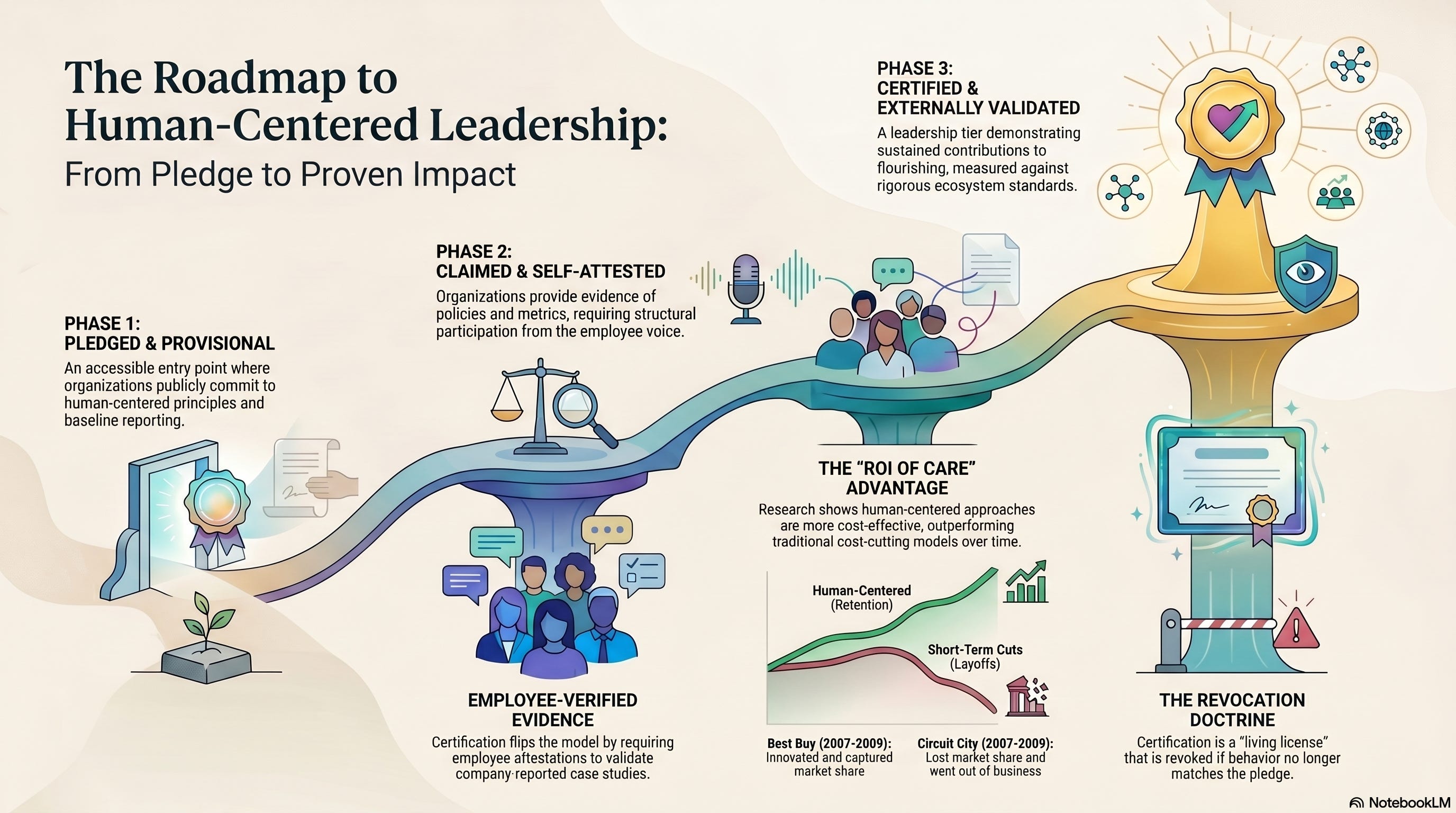
The three-phase approach: What the room described as a provisional approach to certification is better understood as three distinct phases of the H Corp Foundation’s maturation. As we co-create the standards and adopt the metrics together, we will get to new phases with each requiring more evidence than the last.
Phase 1 — Pledged / Provisional: The organization commits publicly to human-centered principles and begins education, assessment, and baseline reporting. A declaration of intent, not a claim of achievement. This is the entry point — accessible, honest, low-barrier. They begin participating actively in the H Corp Council, attending meetings, training sessions, and conferences.
Level 2 — Claimed / Self-Attestation: The organization demonstrates evidence through policies, practices, metrics, employee participation, and documented examples of difficult decisions. Claimed, not yet proven or certified. It was envisioned that, unlike B Corps, this would require employee voice as a structural component.
Level 3 — Certified / Externally Validated: The organization demonstrates sustained contributions to human flourishing with its employees and the markets it serves — contributing case studies to the field, sharing hard-won knowledge publicly, and actively raising the floor for others. This is the leadership tier, not just a better badge. It will be reviewed and measured against the standards that the H Corp Foundation establishes with its member companies and the broader ecosystem.
The certification is a living license, not a trophy. Revocable when behavior no longer matches the pledge or when shown to be undeserved. The revocation doctrine needs to exist before this goes to regulators — they will ask. Chris Heuer affirmed this was the plan, with a simple mechanism for him, as the Chairperson, to make the determination and revoke any membership or license at his sole discretion, as written into the membership contract. He also referenced the need to provide a yet-to-be-designed “disputation arena,” in line with David Brin’s work, to make this process transparent and fair. This revocation process will be refined and expanded over time as an important component of the organization’s broader value and processes, ensuring our mission and values are upheld.
Employee attestation as the crowdsourcing mechanism: Chris floated this mid-session: what if case study submissions had to be initiated by employees rather than PR departments, with X employee attestations required for validation? This flips the model from company-reported to employee-verified. It also creates a structural link between the certification and the people the certification is supposed to protect. No company should receive certification in Phase 2 or 3 without meaningful employee participation in the evidence.
Supporting models cited by participants to review:
Best Place to Work awards: employee-driven, creates organizational pride, forces cultural accountability, companies seek it voluntarily
Prediction markets (example from a China-based company): employees who were closest to the market predicted outcomes more accurately than leadership — employee knowledge as a data source, not just a sentiment check
DoubleClick/IAB precedent: a company that got in trouble, navigated it well, and became a standard-setter. The argument — the company that gets burned and responds right becomes the most credible voice in the room. H-Corp could benefit from finding and featuring that company.
Theme 3: Measurement — What Gets Measured Gets Valued
The problem named: Policy language doesn’t capture human sentiment. The CFO lens doesn’t capture joy or dignity. Current organizational metrics don’t measure what H-Corp cares about — so H-Corp needs to either find existing instruments or build its own.
Existing instruments to adopt or partner with:
John Hagel’s metrics work within the H-Corp community (in progress)
Corey Smith’s Thrivability Index — measuring conditions for human thriving
Carson Kelly’s ROI of Care Framework
Net Trust Score (see below)
Net Trust Score — a specific opportunity: Chris Heuer owns and will be developing the Net Trust Score: an application of NPS methodology applied to trust. How much does the workforce trust leadership? How much do customers trust the brand? This is directly actionable as an H-Corp measurement tool.
The principle: H-Corp or the broader H-Corps/Team Human community should become a convening source for human-centered measurement. The measurement domains that matter are knowable: trust, human agency, AI impact (augment vs. displace), learning and adaptability, flourishing, economic fairness, and long-term organizational value. Credible instruments exist across most of these. H-Corp’s job is to say which ones matter, adopt the best of what already exists, and identify where new instruments are genuinely needed.
Once you establish what you want to measure, you can deploy people to find who’s already doing it. The research role becomes: find the organizations already producing these results naturally, and surface them as exemplars when inviting their participation.
Theme 4: ROI and CFO Language as the Strategic Frame
The core argument (already in H-Corp’s toolkit): Orgvue’s research showing that $1.27 is spent for every $1 saved through AI replacement is informative. This is the proof point that makes the business case. Human-centered approaches aren’t just ethical; they’re more cost-effective over time.
The “chocolate coating” framing: Human-centered principles framed in the language of profitability and ROI. Not “do it because it’s right” but “do it because the numbers support it.” This isn’t a compromise, it’s a translation. It’s how you get CFOs and boards to act.
What the CMO in the room named: He made the case for why this works: “I know inherently this is the right thing to do. You’re giving me the proof points to go to the people, the board, the CFO.” H-Corp’s research and case studies are doing the translation work for advocates who are already convinced but can’t make the internal case without ammunition. That’s a specific, useful product.
The “AND” reframe: Multiple speakers moved toward this: it doesn’t have to be ethics OR profit. It can be AND. The companies that kept people (Best Buy case study) outperformed the companies that cut them (Circuit City). The case is empirical, not moral. That empirical case is one of H-Corp Foundation’s most important content assets.
Theme 5: Historical Context — Where the Pattern Came From
The balance sheet origins: Employees being valued as line items on a balance sheet goes back to slave-era accounting (”Accounting for Slavery” — the book was named). People were literally assets. That accounting logic no longer persists structurally in how modern organizations think about labor. Today it is a liability.
Steve Carnevale’s proposal (at Human+Tech Week): A progressive counter-move, actually valuing employees on the balance sheet as assets, not liabilities. There’s prior research and a podcast on this from Team Flow Institute’s final report at the end of 2025. This is worth pulling forward into H-Corp’s intellectual frame: the accounting change may be where the behavioral change begins, or where it becomes reinforced and accepted by financial markets.
Living wage as the historical exemplar: The Henry Ford reference (paying workers enough to buy what they make) was invoked as the original case study in long-term human-centered thinking. The argument: short-term labor cost reduction destroys the customer base. Ford understood this; most modern executives seem to have forgotten this lesson.
Theme 6: Long-Term vs. Short-Term Thinking — The Empirical Case
Circuit City vs. Best Buy: When Circuit City fired its most experienced (and expensive) employees in 2007, it ultimately went out of business in 2009. Best Buy, facing similar market conditions, kept its people, trusted them, and those employees innovated across the entire company, taking Circuit City’s market share. This is a clean case study that tells our human-centered value creation story. It doesn’t need H-Corp to argue it. It argues itself.
UK youth unemployment: Companies not investing in training or human capital. Young people on the streets. One speaker named this as the predictable consequence of purely short-term labor thinking at scale. It’s coming in some regions. It’s already here in others, such as London, today.
The “French Revolution” frame: Someone made the explicit warning: if organizations don’t provide living wages and human-centered conditions, social upheaval is a potential outcome. Not a moral argument. A historical pattern. The Ancien Régime also thought it was fine until it wasn’t.
The angel investor conversation: One speaker told someone who’d made $500M by selling their companies that replacing an entire marketing industry with AI was something he “could” do but “shouldn’t” because of the overall impact on the economy. Their response: “That conversation is above my pay grade.” This is a failure mode for H-Corp to study: those with the most power to shape it often feel least inclined to think beyond their immediate interests.
Theme 7: Employee Voice and Human Knowledge as Organizational Assets
The prediction market example: A company used prediction markets to surface employee forecasts. The employees, particularly those closest to local markets, outperformed leadership’s projections. This is a mechanism, not just a philosophy: employees know things that don’t show up in the data leadership reviews. It also speaks to James Surowicki’s Wisdom of Crowds and the value of larger data sets.
Change management as the bridge: One speaker framed it as: the real challenge is merging human and machine workflows across business, and the people closest to the problems are human beings. Change management is how you bridge that. The H-Corp certification could include a requirement for change management competency. Some of this also already exists in work from the Team Flow Institute when they wrote a report on People-led transformation and the primacy of people in the people, process, technology triad.
Attestation as voice: The employee attestation idea for case study submissions isn’t just a verification mechanism. It’s a statement that employee voice is structurally required for an organization to be recognized as human-centered. You can’t get the H-Corp seal without your employees’ involvement in the process.
Theme 8: Accountability, Transparency, and Real-Time Response
The IBM futurist frame (SOLOMO): Social, local, mobile, principles from 2006-2010. The “real-time organization” concept: not about avoiding mistakes, but about how quickly you own them and what you do in response. That’s the accountability standard, responsiveness and ownership, not perfection.
What’s still blocking organizations: Silos. Cross-functional political dynamics. Incentive misalignment (sales vs. customer success, for example). These structural problems haven’t been solved despite decades of awareness. It was suggested that H Corp’s certification should address the alignment of incentive structures embedded in structural dynamics, not just value statements.
Transparency of process: Chris mentioned the 40-page foundation overview in NotebookLM, still being edited. The act of making the work public while it’s incomplete is itself a demonstration of the H-Corp principle. That’s worth naming explicitly — H-Corp practices what it seeks to see in the world. We don’t just say what others should do; we need to live it as best as possible.
Theme 9: Fear vs. Love as the Root Organizational Dynamic
John Hagel’s frame: Fear is controlling so much decision-making right now. Fear is also the basis of the authoritarian movements gaining power globally. The same emotional driver operates at both the organizational and societal scale.
Positive psychology as the counter-frame: Traditional psychology asks “what’s wrong?” Positive psychology asks “what’s right?” The entire Team Flow Institute body of work is grounded in this distinction, which is the work H Corp Foundation founder Chris Heuer led prior to our formation. Organizations built around diagnosing and fixing deficits will make different AI decisions than organizations built around amplifying strengths.
“You trust them, they do the right thing”: The Circuit City / Best Buy moment produced one of the clearest articulations in the session: people, when trusted, will learn the tools. Will do what it takes. Nearly every example points in the same direction. This is H-Corp’s core thesis, stated simply.
Messaging implication: H-Corp should not be framed primarily as “preventing dystopia” — even though that urgency is real. The more powerful frame is aspiration, not alarm: the future of work should not be built on fear of human obsolescence. It should be built on confidence in human potential. Doom gets clicks. Possibility gets builders. We get what we focus upon.
The personal frame: Fear-based vs. love-based mindsets. Whether your operating system is scarcity and threat, or abundance and care. Organizations running on fear-based operating systems will automate defensively. Organizations running on love-based (or positive-psychology-based) operating systems will augment.
Theme 10: Community as the Origin of Standards
The IAB origin story: The Internet Advertising Bureau and the standards former in email can trace some of its origins to an apartment in Florida where H Corp founder Chris Heuer also stood. Four people. Small room, big idea. H-Corp is also being born in such a room. This framing is important: the legitimacy of what H-Corp is building doesn’t require scale first. It requires the right people in the right conversation, willing to be wrong in pursuit of figuring out what is right.
Don’t reinvent — find and amplify: Chris Heuer named this explicitly: the tools, metrics, and systems already exist. The work is finding the people who’ve already figured it out and surfacing them. H-Corp is a discovery and validation mechanism, not necessarily or always a creation mechanism. This is a lighter, faster, more scalable approach than building everything from scratch.
Theme 11: The Human-Centered Decision Case Library
The room repeatedly returned to a single idea: organizations are revealed not by their stated values but by what they do under pressure. That’s an asset class H-Corp should actively build.
The Case Library can become a structured, publishable collection of real decisions made under real pressure. Each case could document:
The decision faced — what was at stake, what triggered it
Who was affected — workers, customers, communities
The economic pressure — what the short-term cost of a human-centered choice appeared to be
The options considered — including the non-human-centered path
What the organization chose — and why
What happened afterward — outcomes, measured or observed
What employees say about it — direct voice, not filtered through PR
What others can learn — the transferable principle
This turns H-Corp from a philosophy into a field guide. It also creates the evidentiary base for identifying the very standards we seek to advance and adopt. The hard decisions are the proof. And it generates content that others can carry into CEO/CFO conversations without needing to translate it first.
Theme 12: Mistakes as a Pathway, Not a Disqualifier
The DoubleClick/IAB case study referenced surfaces a principle that needs to be explicit in H-Corp’s design: the organizations that get burned and navigate it right often become the most credible standard-setters, not necessarily the ones scolded for eternity. Redemption is always possible.
If H-Corp feels like a purity test, a seal only already-perfect organizations can earn, it will attract the wrong members and repel the most useful ones. The companies that have made a bad technology decision and want to do better are exactly the constituency H-Corp needs. They have the most to teach. They have the most incentive to be honest. And their public accountability makes the standard real.
The model: Come in honestly. Learn. Measure. Repair. Share what worked and what hurt. That’s how H-Corp becomes a developmental movement rather than a virtue signal. The badge represents a journey, not an arrival.
This has a direct structural implication: the Case Library should actively seek out and document cases where organizations made a mistake, owned it, and changed course. Those cases may be more valuable than the clean success stories.
Connections to H-Corp Core Plan
What the H Corp Foundation event during Human+Tech Week validates:
The certification model is generating real design questions (three-phase evolution, employee attestation, revocation) that need answers before it goes to the boards or becomes more meaningful.
The ROI / CFO language is resonating — the $1.27 cost for every dollar saved by labor cuts is landing
Leadership education is a gap that multiple people independently named — it’s not a niche concern
Measurement (joy, trust, thriving) is unresolved but the appetite is real
Historical context (balance sheet, slavery accounting, Circuit City) strengthens the empirical case significantly
The sequencing principle — movement first: H-Corp is a movement first, a standard second, and a certification third. The badge is not the mission. The mission is changing what organizations believe they are responsible for. This sequencing matters because it changes what success looks like at each stage. In the movement phase, success is the quality of the room. In the standard phase, it’s the rigor of the criteria. In the certification phase, it’s the seal’s credibility. Conflating these phases produces the wrong priorities at the wrong time.
The Question We Still Need to Ask More Deeply
How does H-Corp survive a company that cheats?
Every certification model faces this: what happens when a company earns the H-Corp seal, uses it for PR, and then makes a decision that contradicts it? The Best Place to Work model has faced this criticism. The B-Corp model has faced it harder. The IAB faced it with DoubleClick.
The provisional/phased approach and the employee attestation idea both illuminate this problem without fully solving it. The crowd-sourced case study model helps. But the question isn’t just about detection, it’s about revocation, response, and what H-Corp’s standing is if it endorses an organization that later behaves badly.
If H-Corp is going to go to regulators, boards, and the public at large, it needs an answer to this before someone in that room asks it. They will ask it.
Secondary question we’re not asking:
What is H-Corp’s relationship to labor? Every mechanism proposed today, attestation, living wages, employee knowledge as an asset, and balance sheet valuation. They all have a labor movement analog. H-Corp is threading a needle: pro-human, pro-business, but agnostic (so far) on collective bargaining, union structure, and worker rights. That agnosticism is probably correct for now. But as H-Corp scales and gets policy attention, someone is going to ask where H-Corp stands. Better to have a considered answer than to be caught without one.
H-Corp Foundation — Community Session Agenda
Wednesday, May 20 | Noon–1:30 PM PT Register: https://us02web.zoom.us/meeting/register/M7qyXm6ESbe5yMy3wRLh4A
Before You Join
Read the event report and watch the intro video from Chris Heuer above. Coming in prepared makes the 90 minutes worth it. We won’t be recapping — we’ll be going deeper.
Agenda
0:00–0:10 | Welcome + Framing (Chris)
Brief orientation — who’s in the room, why this moment matters, and the two questions that anchor the session:
What does a human-centered organization actually do differently — and how do we make H-Corp membership mean something real?
Not a rhetorical question. We’re here to make progress.
0:10–0:20 | Full Group: Surface What’s Alive
Open discussion — what from the event report landed hardest? What’s unresolved? What did you come here to dig into?
0:20–0:40 | Breakout Round 1 — The Practice Question (20 minutes)
Different groups, same question:
What does an H-Corp actually do differently, day to day?
What are the 3–5 operational behaviors that distinguish a human-centered organization from one that merely claims to be?
Where does the rubber meet the road — hiring, AI deployment, layoff decisions, incentive design?
What would a new employee notice in week one that they wouldn’t notice elsewhere?
Each group: designate a note-taker and a reporter. Record the session. Come back with 3 specific findings — not summaries, findings.
0:40–0:50 | Report Back: Round 1
Each group’s reporter shares their 3 findings (4 min each, 2 min synthesis). What’s converging across both groups? What’s in tension?
0:50–1:10 | Breakout Round 2 — The Standards Question (20 minutes)
Shuffle the groups. New mix, new question:
What makes H-Corp membership and good standing actually meaningful?
What’s the minimum bar for Phase 1 (Pledge)? What does a company have to do, not just say?
What does the evidence look like for Phase 2 (Self Attested)? Who provides it, and how do we prevent gaming the system?
What’s the revocation trigger? Who decides, and how is it made fair?
How do mistakes become a pathway rather than a disqualifier?
Same discipline: note-taker, reporter, 3 findings.
1:10–1:20 | Report Back: Round 2
Each group’s reporter shares their 3 findings. Full group: what’s the one thing that must get resolved before H-Corp can move to accept membership?
1:20–1:30 | Close + Commitments
What are the open loops that matter most?
Who’s taking something forward?
What’s the next session, and what will it need?
Chris closes with what he heard and what it means for the Foundation’s next move.